
Enigma Newsletter: Business Identity for Agents
Chatbots have gotten pretty good at answering the kind of question we used to ask a search engine: how long to cook a turkey, why the sky is blue, where the comma goes in a plural possessive. Compliance questions live in a completely different category. Does the LLC on this vendor application have a corporate registration in good standing? Has its registered agent terminated the relationship? Are its beneficial owners on a sanctions list under a different entity name?
When an agent confidently reports that a business is active and in good standing, then a human checks and finds the entity dissolved eight months ago, that’s a data-layer failure showing up at the model layer. Fix the data and the failure largely disappears. That’s the work that just landed us in Parallel’s new reference data source Index alongside The Atlantic, Fortune, and others.
Sources of Record
Index is a marketplace that compensates data providers by their actual contribution to an agent’s inference rather than by per-access fees or citation counts. The underlying math is called Shapley value: each source earns by what it adds to specific agent tasks, not by crawl volume or mention counts. A dashboard at index.parallel.ai shows providers how agents are actually using their content, and game theory does the rest.
PitchBook and Fiscal AI among the data providers, The Atlantic among the publishers. The shared proposition: agents reaching for verified business data reach for the same kind of providers they get for verified market data and verified journalism. Index puts a price on that, and reframes the agent/content-owner relationship from extraction to participation.
Grounded Data
What we bring to Index, and to every agent surface, starts with primary sources. Every U.S. Secretary of State filing, FinCEN beneficial-ownership submission, professional licensing record, and authoritative business registry, normalized into a unified schema with documented refresh cadences. When the Texas Secretary of State marks an LLC dissolved on a Tuesday, our records reflect it by Thursday. The agent reaching for that entity sees the change before it makes the next decision. Three failure patterns recur in agentic workflows: wrong-entity match, stale-state error, and ownership blindspot. Each is a data-layer issue surfacing at the model layer. On entity-resolution benchmarks, leading frontier models with web search alone hit 37–51% accuracy. Paired with our identity graph, even small models like Gemini 2.5 Flash clear 70%, at a fraction of the inference cost.
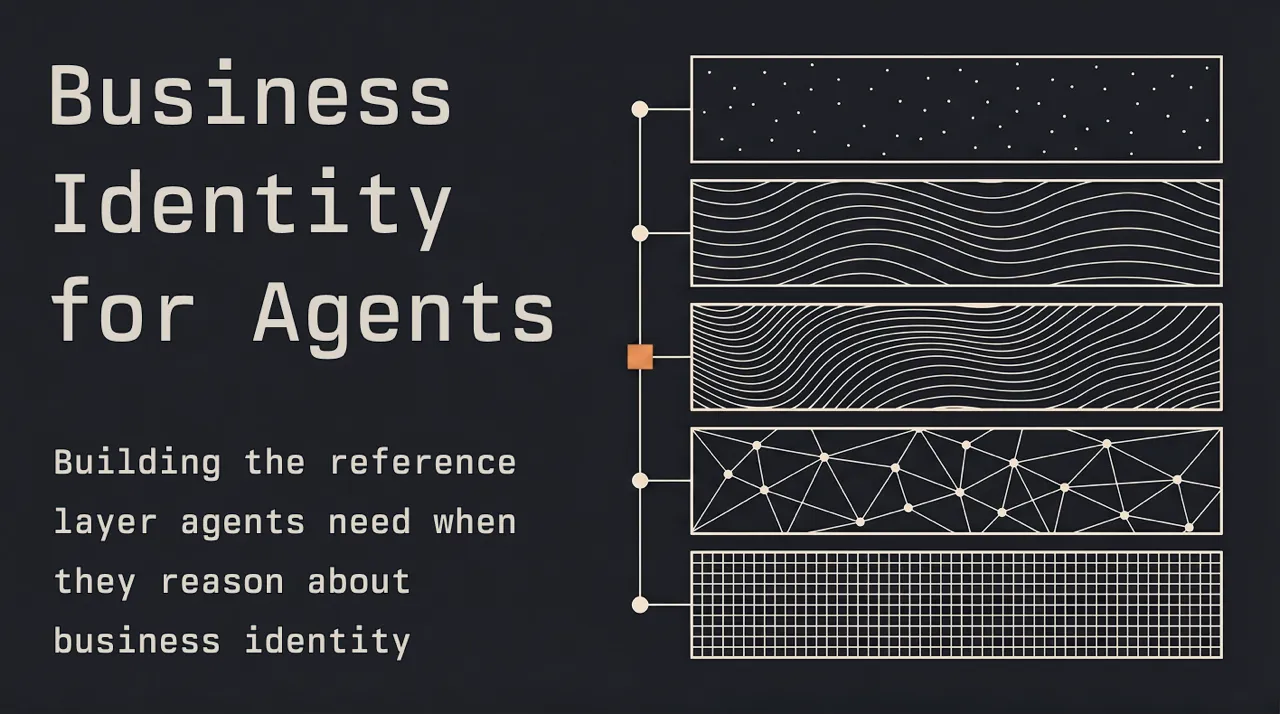
Then comes entity resolution: turning the fragmented records of a single real business (filed differently across jurisdictions, listed differently across sources, named differently across applications) into one coherent identity. Probabilistic, multi-signal, confidence-scored. Entity resolution is the second of five layers running from sourcing through decisioning; failures there cascade upward through everything an agent does.
The knowledge graph picks up where the records end. Our identity graph holds 100 million legal entities, 30 million brands, and 30 million operating locations, linked by ownership and control. An LLC at the surface, three holding companies in the middle, one human at the bottom (sometimes on a watchlist under an entirely different name): the operation that matters most is traversal. Know Your Agent (KYA, the framework currently competing for the same air as KYB), is solving a different trust problem at a different layer.
Connecting to Agents
Any MCP-compatible agent (Claude, Cursor, Codex, or whatever the enterprise standardizes on next) calls our identity graph directly for entity status, ownership traversal, and freshness state, no custom integration required. Beta feedback was pointed: “Nobody wants their old workflow anymore.”
Compliance teams get a chat interface for single-business onboarding and a spreadsheet path for batch screening. Ask whether a new merchant passes, and our KYB Compliance Agent walks the API calls, applies your policy thresholds, and shows the work. It supports A2A, so it plugs into the larger multi-agent workflows you’re already building. It runs on Google’s Agent Development Kit and Gemini 2.5 Flash, available in Google Cloud Marketplace.
There’s deeper work behind each layer: continuous monitoring as business state changes, ownership traversal past the entity on the application, and confidence-gated handoff when the agent isn’t sure.
Talk to us if you’re building agents that need verified business identity.