
Match Points: A Field Guide to Business Identity
Closing the gap between paper presence and operating signals
On paper, most risky businesses look ordinary. A storefront has a familiar brand on the awning, a tidy LLC on file in Delaware, and a mailbox that never misses a certified letter. An aggregator submits a neat spreadsheet of sub-merchants. A healthcare supplier shows a string of active registrations. Then the money starts moving — and only later do investigators learn the brand was a franchisee with no real operations, the sub-merchants were shells, and the supplier’s “office” was a commercial mail receiving agency.
These failures result from treating registration artifacts as proof of a living business.
Modern KYB work lives in the gap between what a company says it is, what the filings imply, and what the operating signals can actually support. That gap is widest in familiar patterns: sole proprietors trading under DBAs, clusters of entities at the same registered-agent or virtual address, franchise locations whose legal entities don’t match the brand on the door, and networks that reuse phones, domains, and maildrops to obfuscate control.
This article looks at where KYB breaks down in the real world — and how to close those breaks with signals that reflect how businesses actually operate.
The Paper-Only Problem
239,000 brands in Enigma’s business graph have valid registration artifacts — an LLC filing, a registered agent address, an “active” status — but show zero operating signals. No card revenue in the past 12 months. No customer reviews. No phone number or website. No open locations.
Some of these “paper-only” businesses are legitimately dormant — side projects, holding companies, structures awaiting activation. But many are the raw material of fraud: shells used to launder transactions, nominees that exist only to receive certified mail, or application-mill artifacts designed to pass automated onboarding checks.
The problem compounds when onboarding teams have seconds, not hours, to decide. A Delaware LLC with a registered agent and an “active” status looks identical whether it’s a real operating business or a front. Standard KYB checks — registry lookup, OFAC screening, address validation — are often not enough to separate paper presence from operating reality.
Where Risk Hides: Address Clusters
Registration addresses can lie — not always, but often enough to matter.
Enigma’s data reveals that 934 likely registered-agent or commercial mail receiving agency (RA/CMRA) addresses host extreme concentrations of brands — with one location hosting 1,913 brands. These locations host hundreds of entities with the same mailbox, and yet only 21% show card revenue in the past year.
These addresses are friction reducers. They let a new business incorporate quickly, receive legal mail reliably, and maintain a clean paper trail. They also generate opacity. When 300 LLCs share the same suite in Wilmington, Delaware, distinguishing the legitimate businesses from the shells requires more than a registry check.
Enigma’s address intelligence flags these patterns automatically: registration vs. operating address splits, virtual/CMRA indicators, residential vs. commercial classification, and deliverability context. When a merchant’s operating address is a real storefront in Brooklyn but its registration address is a mail drop in Dover, that mismatch is a signal — not proof of fraud, but enough to escalate the review.
But here’s the highest-risk pattern: entities that cluster at RA/CMRA addresses and show no operating presence anywhere else. These are candidates for the “shell merchant” pattern that enables transaction laundering and aggregator blind spots.
Industry Risk: Where Paper Entities Concentrate
Not all industries carry the same KYB risk. Some sectors — religious institutions, cemeteries, certain holding structures — legitimately operate without generating card revenue or online reviews. Others show unusually high paper-only rates for less obvious reasons.
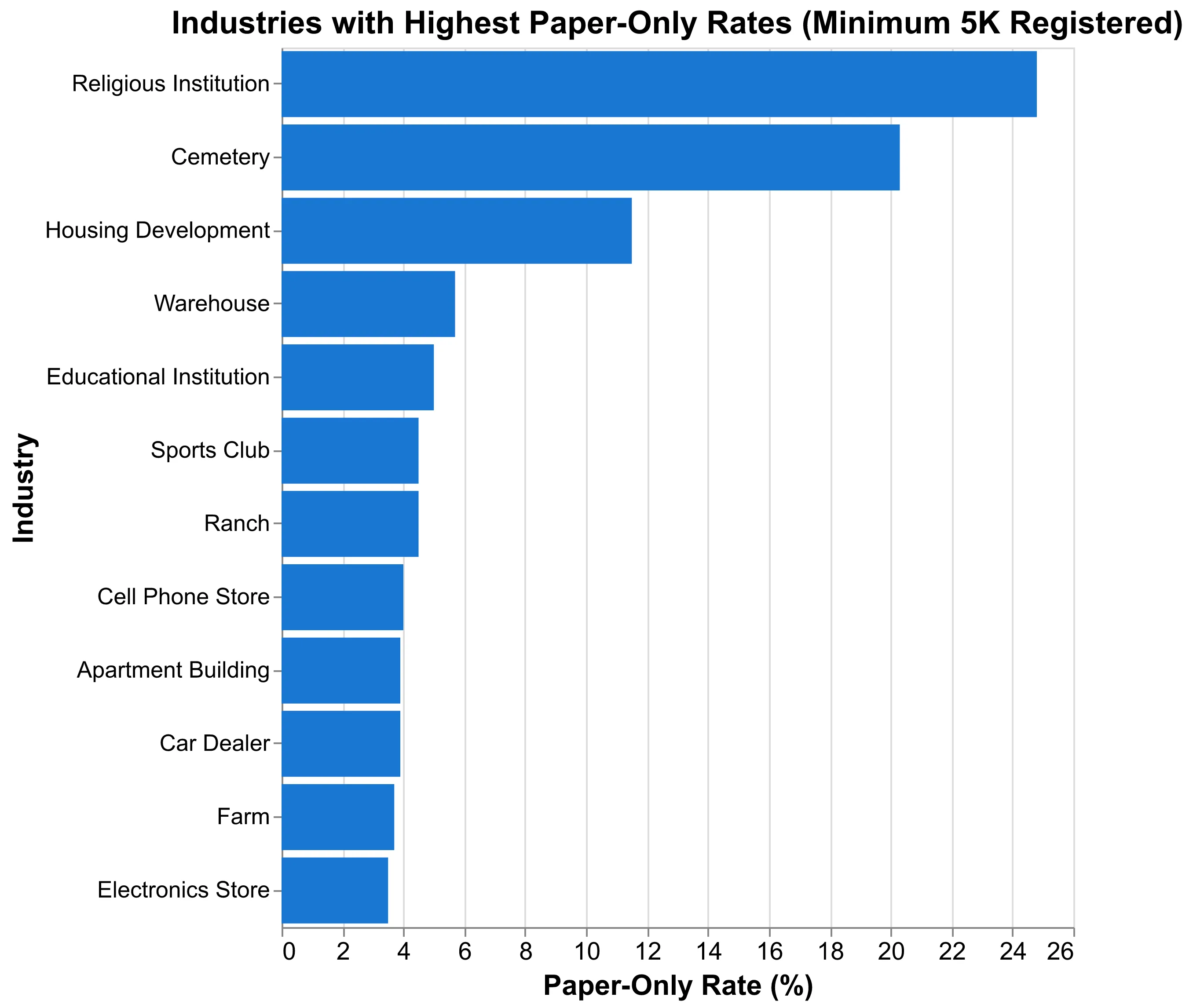
Among industries with 5,000+ registered entities:
- Religious institutions have a 24.8% paper-only rate
- Cemeteries have a 20.3% paper-only rate
- Housing developments have a 11.5% paper-only rate
High paper-only rates don’t always signal fraud — they often reflect legitimate business models where standard operating signals are sparse. But they do signal onboarding risk: these sectors require manual review because automated checks can’t distinguish dormant-but-legitimate from never-was-real.
Healthcare is a particularly complex case. 3,412 addresses host 5+ healthcare-related brands each, with a 33% revenue rate. Some of these are legitimate medical office buildings or hospital campuses. Others match the profile of nominee billing operations — entities spun up rapidly, clustering at shared addresses, showing minimal revenue or patient-facing activity.
Enigma’s edge: Cross-referencing address clusters with operating signals (revenue, reviews, multi-location presence, licensing context) helps distinguish real medical facilities from paper entities designed to submit claims.
The PPP-Era Surge
The 2020-2021 PPP era offers a natural experiment in business formation patterns. During those two years, 974,000 new brands were formed — 21% more than in the prior two-year period.
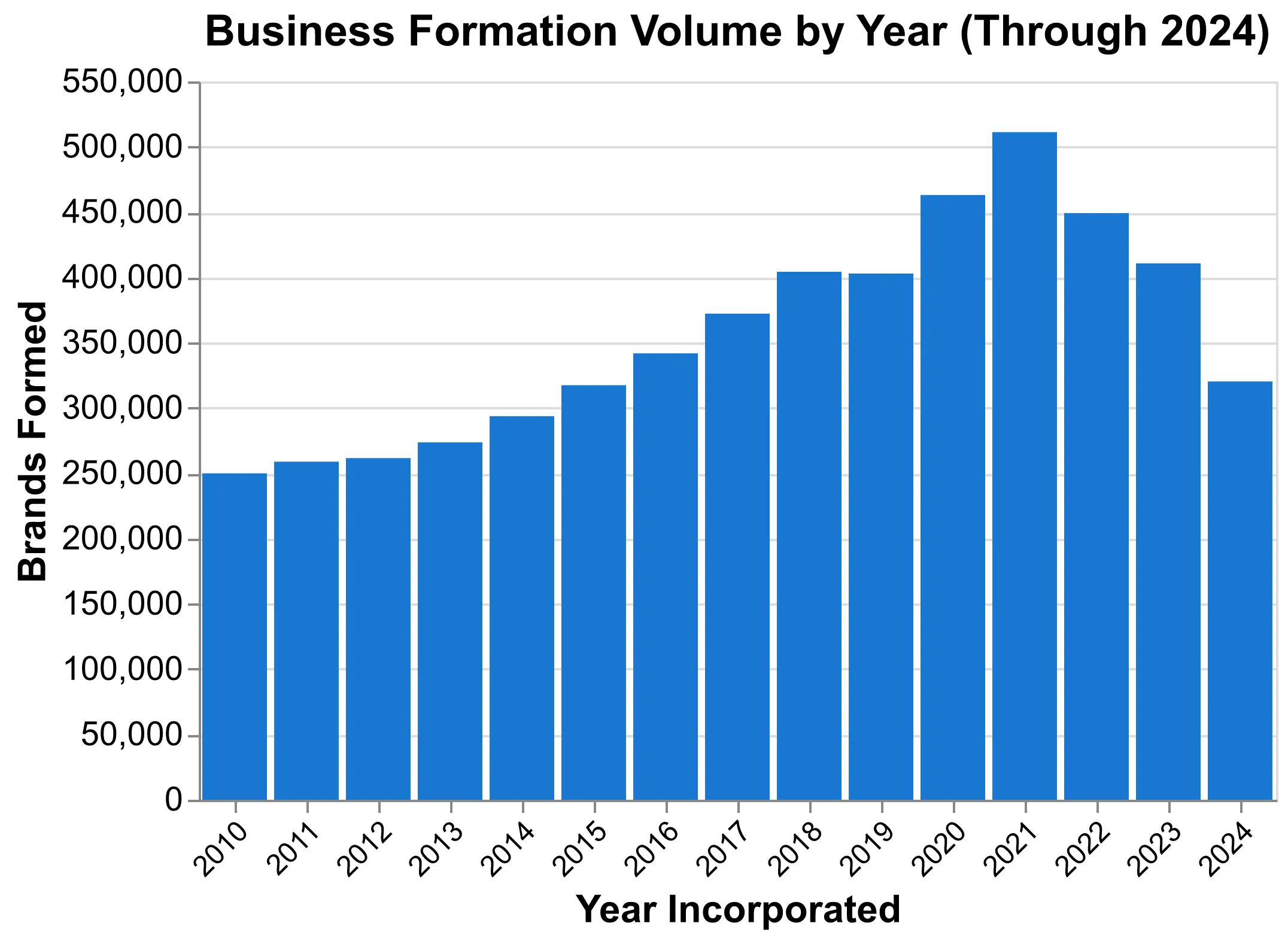
Counterintuitively, the paper-only rate declined during the PPP era, from 2.1% in 2018-2019 to 1.4% in 2020-2021. This likely reflects:
- Many legitimate businesses forming to access relief funds
- Fraudulent entities generating some operating signals to pass verification
- Older cohorts having more time for legitimate businesses to go dormant
The fraud signal is new formation + virtual address + no operating signals + sudden transaction activity — a multi-factor pattern that requires layered screening.
Zombie Entities: When Old Businesses Come Back to Life
Perhaps the most insidious pattern is the zombie entity: a business registered years ago, dormant for its entire existence, then suddenly showing transaction activity.
Among entities 10+ years old, 2.5% are zombies — valid registration, zero operating signals, no historical revenue or reviews. That’s 140,000 zombie entities in the 10+ age cohort alone.
This pattern is consistent with:
- Purchased shelf corporations used for PPP fraud or bank account fraud
- Business email compromise schemes impersonating dormant entities
- Money laundering operations using aged entities with clean histories
Enigma’s edge: Operating signal timelines reveal when an old entity suddenly “comes to life” — a pattern invisible to static registry checks but obvious when you track revenue, reviews, and transaction history over time.
Rapid Proliferation: The Check-Cashing Shell Pattern
Twenty-seven US addresses show rapid entity proliferation — 10+ brands formed within a 3-year window, clustering at the same location. On average, these addresses have only 35% of brands showing card revenue.
This temporal clustering pattern is consistent with:
- Check-cashing and funnel account schemes that cycle through shell entities
- Application mill operations generating entities at scale
- Nominee billing networks in healthcare and other sectors
Enigma’s edge: Temporal clustering + operating signal correlation identifies suspicious networks that look legitimate when viewed individually but reveal their structure when analyzed as a graph.
Contact Graph Signals: Shared Phones, Domains, and Registered Agents
Multiple brands sharing the same phone number or website can indicate:
- Legitimate: Franchise systems, management companies, shared services
- Suspicious: Nominee structures, shell networks, white-label fraud operations
When combined with other risk signals — RA/CMRA addresses, paper-only status, rapid formation — contact reuse becomes a key indicator of coordinated networks designed to evade KYB controls.
Franchise Confusion: The Right Brand, The Wrong Legal Entity
26,000 brand names appear with 3+ different legal entities, suggesting franchise structures, DBAs, or multi-entity operations.
The onboarding risk: Payment processors may onboard “McDonald’s LLC #472” thinking it’s the corporate entity, when it’s actually an independent franchisee with different risk characteristics. Merchant acquirers may verify a storefront showing “Subway” without realizing the legal entity is “John’s Sandwich Holdings LLC” — a structure that obscures beneficial ownership and complicates chargebacks.
Enigma’s Brand Search Model resolves storefront → brand → legal entity, ensuring the correct entity is being onboarded. DBA mapping shows when “John’s Pizza” is actually registered as “ABC Holdings LLC” — critical for beneficial ownership verification and UCC filings.
The V2 Playbook: Signals That Close the Gaps
Enigma’s KYB v2 is designed for these edge cases. The core capabilities:
1. Person + TIN Verification
- Person verification (including SSN where permitted) to close the sole-proprietor gap
- TIN context (EIN vs SSN) so reviewers know whether they’re looking at an entity or an individual
2. Address Intelligence
- Registration vs operating address split detection
- Virtual/CMRA and residential/commercial flags
- Deliverability and suite normalization for accurate matching
3. Brand-from-Location Resolution
- Brand Search Model links storefronts to the right brand and legal entity
- DBA mapping reveals when operating names differ from legal registrations
- Franchise indicators flag when a local LLC operates under a national brand
4. Confidence Tiers + Reason Codes
- Match confidence scoring for automated review routing
- Reason codes explain escalations (name mismatch, address risk, missing operating signals)
- Audit trails make decisions explainable and defensible
5. OFAC Integration
- Entity + person screening against OFAC watchlists
- In-flow sanctions checks keep compliance in the same workflow as identity verification
- Cross-alias matching for sanctions-evasion detection
A Practical Appendix: KYB Failures and the Signals Enigma Uses to Catch Them
.gtm-table { border-collapse: collapse; width: 100%; font-family: Arial, sans-serif; font-size: 14px; } .gtm-table th, .gtm-table td { border: 1px solid #ccc; padding: 10px; text-align: left; vertical-align: top; white-space: pre-wrap; } .gtm-table th { background: #f6f6f6; } .gtm-table th:first-child, .gtm-table td:first-child { width: 28%; } .gtm-table th:nth-child(2), .gtm-table td:nth-child(2), .gtm-table th:nth-child(3), .gtm-table td:nth-child(3) { width: 36%; }
Failure Mode
Enigma V2 Signals
Auto-Review When
Shell merchants(transaction laundering)
Brand-from-location; virtual/CMRA; registration vs operating mismatch; web presence thin; phone/email reuse; high-risk MCC + volume patterns; rapid merchant churn; address density
Operating address missing or virtual-only; MCC + category mismatch; no credible website; contact reuse across many merchants; abrupt volume spike; high refund/chargeback proxy signals
Aggregator sub-merchants(hidden high-risk)
Location→brand/legal step-up; residential/commercial mismatch; web footprint vs claimed product; contact networks (shared phone/email); sub-merchant clustering at same RA/CMRA; rapid formation
No operating signals; recycled contacts across many entities; multiple brands tied to one location/person; thin web presence; high-risk vertical indicators; repeated CMRA
PPP-style mills (mass fraudulent applications)
Person verification (SSN); formation date + operating signals gap; business age; industry mismatch; multi-entity linkage; address density; virtual address; bank account reuse signals (if available)
New entity + mailbox + no operating site + thin web; multiple similar entities sharing contact; anomalous payroll/volume claims vs operating evidence; repeated addresses
Healthcare roll-ups(nominee DME/labs)
Person↔business linkage; operating vs registered addresses; licensure/certification (if integrated); high-risk location clusters; shared phones/emails; rapid NPI-like proliferation proxies; corporate structure complexity
Many entities share RA/CMRA and phones but lack operating evidence; newly formed healthcare entities with high billing volume indicators; address density; inconsistent branding
Sanctions-evasion fronts(trading/trans-shipment)
OFAC screening (entity/person); cross-alias matching; jurisdiction risk; shipping/industry codes vs operating footprint; import/export proxies; complex ownership; rapid address changes
High-risk jurisdictions + thin operating evidence; recent formation; opaque ownership; mismatched industry/location; sanctions hits/near-matches; frequent name/brand changes
Synthetic identity businesses(fabricated owners)
Person ID resolution; SSN/identity validation; name/address/phone coherence; phone age; email domain quality; multi-entity reuse of owner; lack of credit/identity footprint (if integrated)
Owner fails verification; inconsistent person attributes across sources; owner linked to many newly formed entities; virtual address + no operating evidence; disposable email/phone patterns
Nominee directors & straw owners
Graph linkages: person controls many entities; shared addresses/phones; rapid filings; role overlap (registered agent/officer); ownership opacity; same nominee across states
Officer/owner appears across many unrelated entities; RA/CMRA heavy; repeated contact info; mismatch between claimed ops and footprints; complex layers without operations
Cash-intensive businesses misrepresented
MCC/NAICS mapping vs description; location type (residential) vs cash-heavy claims; web presence; reviews/POI presence; hours; signage proxies; high-risk vertical patterns
Cash-heavy vertical claimed but residential address; no POI signals (maps/reviews); MCC mismatch; no operating hours/phone listing; sudden volume spikes
E-comm drop-ship / counterfeit
Website age, content quality; product category risk; brand/trademark mismatch proxies; fulfillment address mismatch; contact networks; customer service signals; jurisdiction risk
Thin/templated website; recently registered domain; high-risk product categories; inconsistent addresses; contact reuse; no returns/support footprint
Charity/NGO diversion
Nonprofit status validation (if integrated); board/officer linkages; donation platform mismatch; address type; web presence; rapid formation; related-party networks
New nonprofit w/ virtual address and minimal online presence; officers tied to many entities; unclear programs; high-risk jurisdiction; mismatch between stated mission and ops footprint
Real estate / escrow misuse
Industry + licensing (if integrated); operating footprint; address type; ownership complexity; multiple entities per address; high-value transaction patterns (if available)
Escrow/real estate claimed with no licensing/operating signals; virtual address; opaque ownership; multiple related entities; high-risk jurisdiction ties
From “Looks Fine on Paper” to “Verified, Explainable, Defensible”
The gap between paper presence and operating reality is where KYB fails. Registration artifacts — an LLC filing, a registered agent, an active status — are easy to manufacture. Operating signals — revenue, reviews, deliverable addresses, phone validation — are not.
Enigma’s KYB v2 closes that gap with multi-signal verification that weights operating presence over paper artifacts. Confidence tiers escalate low-signal entities for manual review. Address intelligence flags CMRA/RA concentration. Person verification handles sole proprietors. OFAC integration keeps sanctions checks in-flow.
The result: fewer false positives, faster true-risk detection, and decisions that are auditable from day one.
Our Methodology
Data source: Enigma’s full “Brands” database, a pre-flattened SQL delivery table combining brand profiles with embedded corporate registrations, addresses, contacts, and card transaction signals. December 2025. Universe: ~32.5 million brand entities.
Scoring
Paper presence (0–3 points): Has registration (+1), registration active (+1), has registered agent (+1).
Operating presence (0–5 points): Card revenue in past 12 months (+1), customer reviews (+1), phone on file (+1), website on file (+1), open location (+1).
Confidence tiers: High (operating ≥4), Medium (2–3), Low (1), Paper-Only (operating=0, paper>0), Unknown (neither).
Classifications
Address clusters (20+ co-located brands):
- Likely RA/CMRA: 100+ brands, <30% with revenue
- Possible RA/CMRA: 50+ brands, <40% with revenue
Temporal patterns:
- PPP era: Incorporated 2020–2021
- Zombie entities: 10+ years old, paper score ≥2, operating score = 0
- Rapid proliferation: 10+ brands at same address within 3-year window
Franchise detection: Same brand name with 3+ distinct legal entities across 5+ records.
Limitations
Revenue signals are based on card transactions; cash-only businesses may appear as paper-only despite genuine operations. Some industries (religious institutions, cemeteries) legitimately lack card revenue or online reviews. Contact graph analysis (shared phones/domains) was limited by field availability.