Enigma Newsletter: The Drug Testing Lab Industry
The Drug Testing Divide
In December 2024, ProPublica reported on widespread accuracy problems at Averhealth, a drug testing company used in Michigan child welfare cases. Faulty tests led to false positives that separated parents from their children — sometimes for months — before these errors were discovered.
The investigation raised questions about quality control across an industry that affects millions of workers, job applicants, and families involved in the criminal justice system. How is this industry structured? And who’s doing the testing?
Enigma’s analysis of 1,289 drug testing labs reveals a fragmented industry with striking geographic patterns. The South has more than twice as many labs per capita as the Northeast, while states where marijuana remains illegal have about 50% higher lab density than legal states. And the distribution doesn’t follow simple explanations.
The Geographic Pattern
The South leads the nation with 4.0 drug testing labs per million residents — 2.5 times more than the Northeast’s 1.6 per million. But the map reveals a pattern that cuts across regional lines: states with large oil, gas, and mining industries cluster near the top regardless of region. Wyoming — a state with a small population where energy extraction dominates the economy — leads the nation by a wide margin. Other states focused on energy industries like Colorado, Louisiana, North Dakota, and Montana round out the top five. Federal DOT and pipeline safety regulations require drug testing for many roles in these industries, which may help explain the concentration.
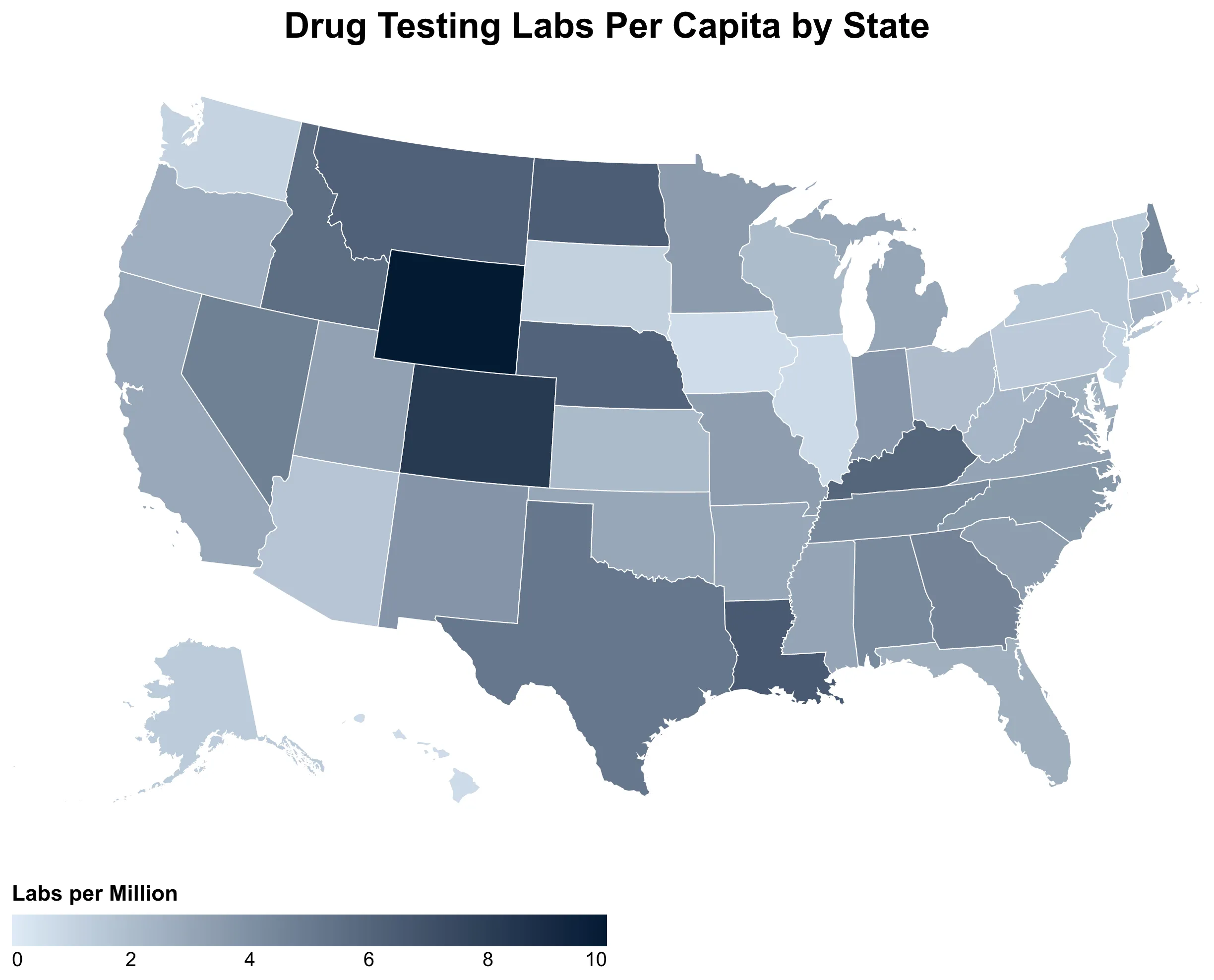
Colorado’s position is particularly striking: it was the first state to legalize recreational marijuana in 2012, yet it has 8.2 drug testing labs per million — more than five times New York’s 1.6. The answer likely lies in Colorado’s Western Slope, where labs in cities like Rifle and Grand Junction serve the oil and gas workforce.
Texas has the most labs in absolute terms (157), but its per-capita rate of 5.1 per million is only middle of the pack. Meanwhile, Illinois — one of the nation’s largest economies — has just 9 labs statewide (0.7 per million), one of the lowest rates in the country. Maine has zero drug testing labs due to a unique policy requiring samples to be sent to certified facilities in other states.
The Cannabis Correlation
States where recreational marijuana is not legal have 3.8 labs per million — 1.5 times more than legal states’ 2.5 per million. You might expect the opposite: more testing in states where marijuana is legal as employers try to enforce workplace drug policies. Instead, legalization appears to be associated with reduced demand for testing services.
But the pattern isn’t uniform. Some states with legal marijuana (like Colorado) still have high lab density, while some prohibition states have relatively few labs.
Explaining Regional Patterns
Several factors could contribute to the South’s higher testing rates:
Industry composition: States with large transportation, energy, or manufacturing sectors may have more testing because federal safety regulations (DOT, PHMSA) require it for certain roles—though we cannot verify which industries our identified labs primarily serve.
State regulatory environment: States with permissive drug testing laws have nearly twice the lab density (4.1 per million) as restrictive states (2.3 per million). Permissive states allow broader pre-employment screening and random testing, while restrictive states limit testing to safety-sensitive roles or reasonable suspicion.
Workers compensation incentives: Many states offer insurance premium discounts (5-10%) to employers with drug-free workplace programs, though these vary by state.
Court and probation testing: Drug testing isn’t just for employment — labs also serve criminal justice systems. States with more drug courts or probation programs may need more testing infrastructure.
Data limitations: Our name-matching approach may identify labs more easily in some states than others, especially if naming conventions differ.
A Fragmented Industry
Unlike many healthcare sectors, the drug testing labs we identified appear highly fragmented. The median lab generates only $29,741 in annual revenue through credit card transactions, suggesting small, independent operations.
This fragmentation raises questions about standardization. In December 2024, ProPublica reported on accuracy concerns with one testing company (Averhealth) in Michigan child welfare cases. While that case involved a larger operator, the prevalence of small independent labs suggests the industry may lack the resources for rigorous quality control systems.
The Bottom Line
Drug testing lab density varies dramatically across American states, driven by some combination of:
- Federal safety testing requirements in specific industries
- State laws that make testing easier or harder for employers
- Workers compensation insurance incentives
- Criminal justice system demand
- Regional workplace culture
- Marijuana legalization status
For businesses operating across states, this means navigating wildly different testing norms. For workers, whether you’re tested may depend as much on where you work as what you do.
What’s clear is that marijuana legalization alone doesn’t predict testing rates — the story is more complex.
Methodology
Data source: Enigma business intelligence data (brands and operating locations)
Sample size: 1,289 drug testing labs identified via name pattern matching
Identification approach:
- Included: Businesses matching drug testing keywords in name (toxicology, specimen, DOT testing, drug screen, etc.)
- Excluded: Substance abuse treatment centers, sober living facilities, rehab programs
Key definitions:
- Drug testing labs: Facilities advertising drug testing, toxicology, workplace screening, or specimen collection services
- Per capita rates: Labs per million residents using 2023 Census population estimates
- Marijuana status: Based on recreational legalization status as of 2024
- Regulatory categories: PERMISSIVE/MODERATE/RESTRICTIVE based on state employment law classifications (sources: SHRM, Littler, state labor departments)
Limitations:
- Cannot verify which industries or employers these labs serve - Pattern matching on business names identifies facilities but not their client mix
- May include non-workplace testing - Labs may primarily serve court-ordered, medical, or sports testing rather than employment screening
- Incomplete coverage - Name-matching likely misses hospital labs, occupational health clinics, and testing services without relevant keywords
- No testing volume data - Facility count doesn’t measure actual testing activity or market concentration
- Industry employment data not analyzed - Correlation between lab density and industrial composition is inferred, not proven
- Simplified regulatory categorization - State laws are complex and don’t fit neatly into three categories
- Revenue data available for ~40% of labs
- Data reflects business registrations as of snapshot date — and may not capture recent closures or openings
External sources:
- State marijuana legalization timeline: NCSL/NORML
- State drug testing laws: SHRM, Littler, state labor departments
- Population estimates: U.S. Census Bureau 2023