
When Compliance is Skin Deep
How Med Spas Navigate — and Sometimes Evade — Medical Practice Regulations
When New York State investigators inspected 223 medical spas in late 2024, they found violations at 87 facilities(paywall) — including expired products, suspected counterfeit injectables, and at one location, controlled substances including fentanyl. According to the Department of State’s warning to consumers, 100% of the facilities they inspected were offering medical procedures without proper licensure, and 73% lacked medical oversight during procedures.
Enigma’s analysis of 12,646 med spa businesses nationwide reveals a structural pattern that helps explain these findings: 85.9% of med spas nationwide classify themselves under beauty industry codes rather than medical facility codes, potentially allowing them to avoid the stricter licensing, inspection, and medical director requirements that traditional medical practices face.
The Human Cost
Before examining the data, it’s important to understand what’s at stake. Beyond this month’s crackdown in New York, recent incidents documented by major outlets highlight the consequences of inadequate oversight:
- Texas (2023): A patient died after receiving IV therapy at a med spa where no licensed medical professionals were present. The unlicensed owner personally administered the treatment.
- California (2021): A patient contracted a drug-resistant infection after receiving fat-dissolving and vitamin injections at a Los Angeles med spa, resulting in $2 million in medical debt and permanent scarring after two years of treatment.
- Pennsylvania (2023): A court awarded $1.25 million after a nurse with a suspended license performed facial injections at a med spa.
New York’s investigation documented similar risks: unsanitary conditions with used needles in overflowing sharps containers, medications stored in refrigerators alongside staff lunches, and unlicensed practitioners performing procedures that can cause burns, infections, and allergic reactions.
A Rapidly Growing Industry
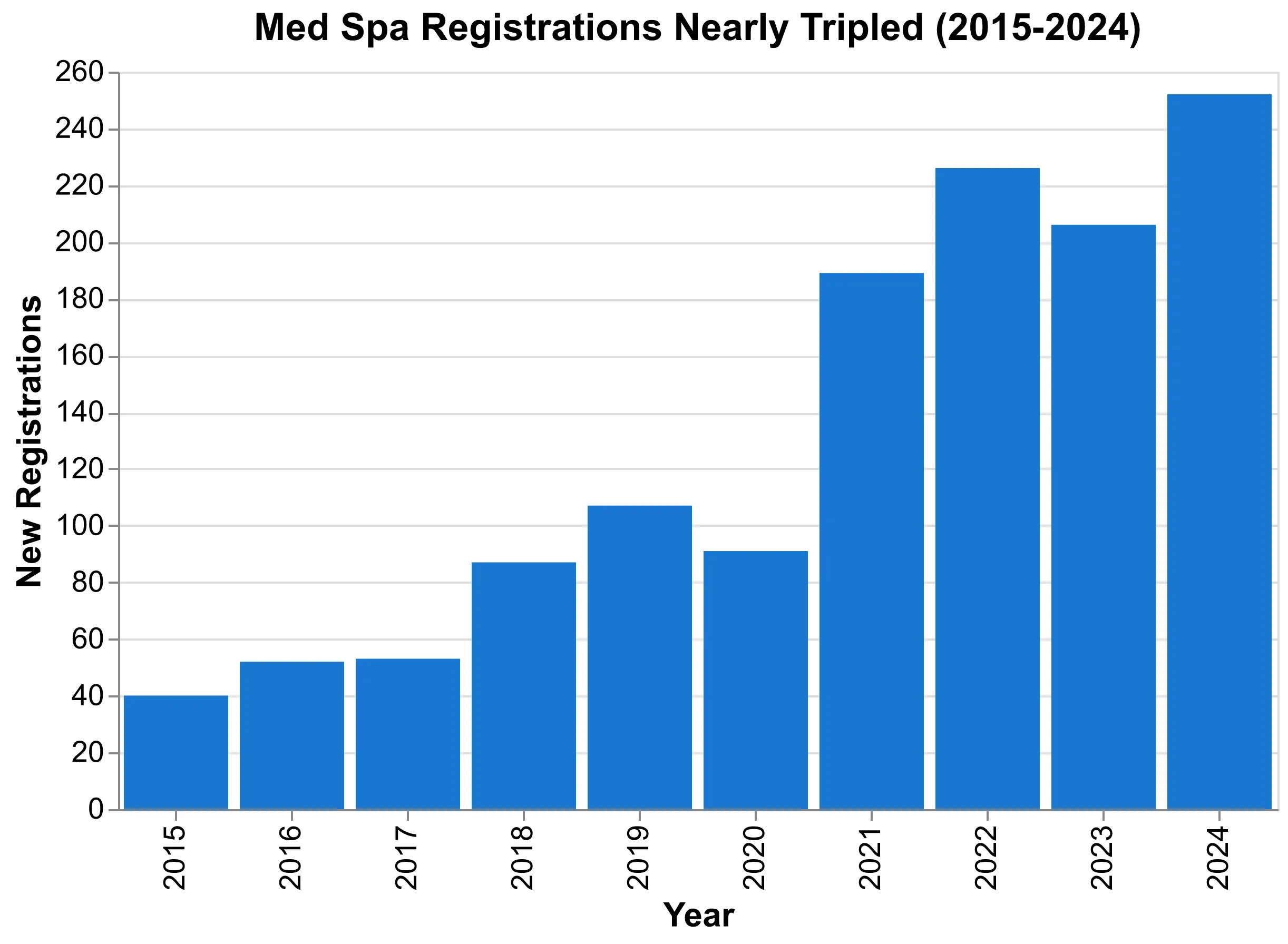
The med spa industry has shown explosive growth over the past decade, with annual business registrations nearly tripling from 91 in 2020 to 252 in 2024. This growth reflects changing consumer preferences toward aesthetic medicine and wellness services that combine medical procedures with a spa-like experience—and an estimated $3.5 billion in annual revenue nationwide.
But as the industry has boomed, its regulatory structure has remained ambiguous. Med spas offer medical procedures — injections, laser treatments, chemical peels — that typically require physician oversight. Yet many operate under business structures designed for hair salons and day spas.
The Classification Gap
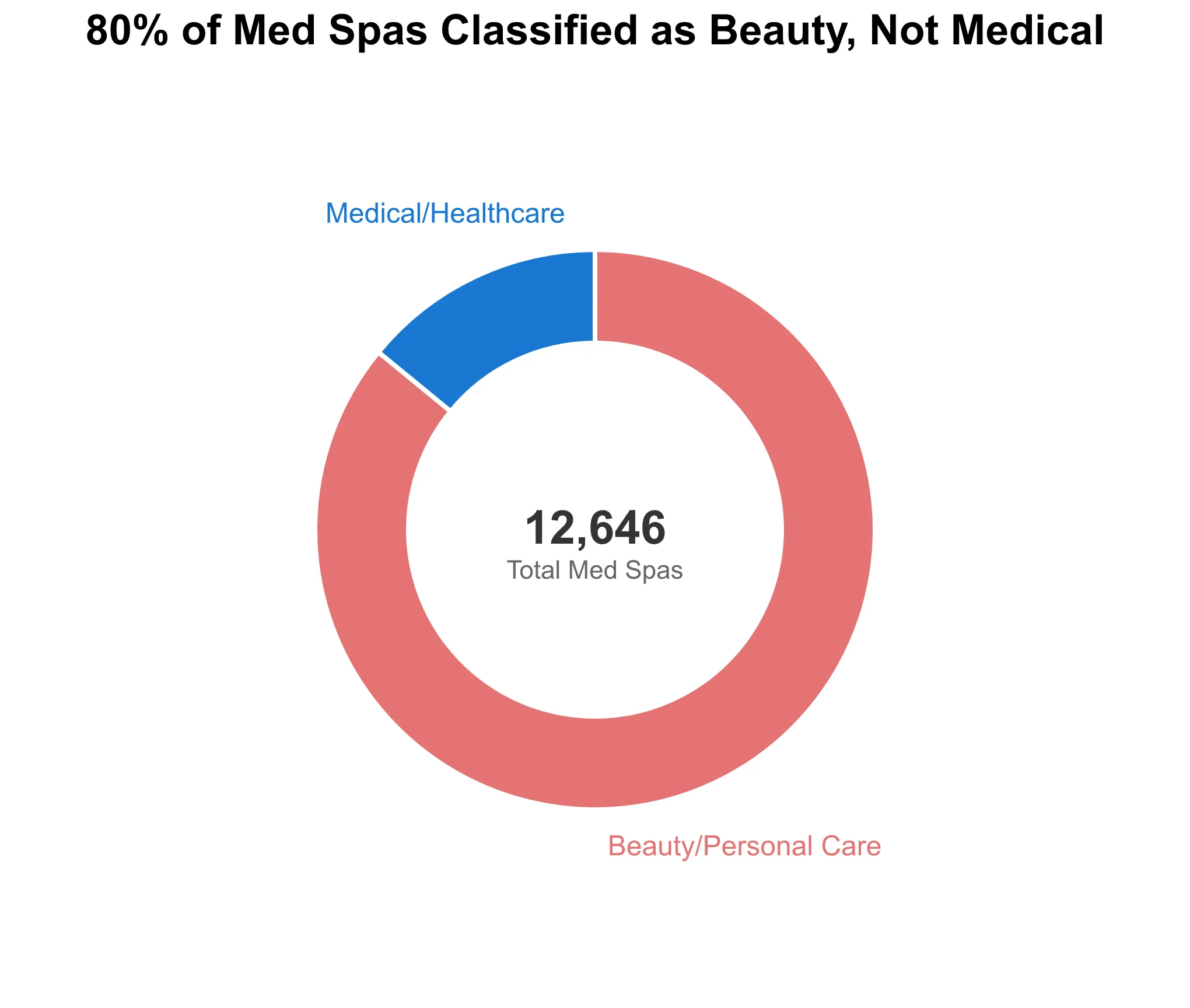
Our analysis reveals that 85.9% of med spas nationwide — some 10,175 businesses — classify themselves under NAICS code 812 (Personal Care Services: nail salons, spas, and beauty shops) rather than NAICS code 621 (Ambulatory Health Care Services: medical offices and clinics).
This matters because business classification often determines:
- Which state agency conducts inspections (cosmetology boards vs. medical boards)
- What licensing requirements apply to the business and its practitioners
- Whether a medical director is required to be present during procedures
- What liability insurance minimums are mandated
- How frequently facilities undergo safety inspections
Important caveat: Many med spas may legitimately classify as personal care services if they primarily offer non-medical spa treatments. NAICS codes are self-reported, and the classification system wasn’t designed for businesses that blur the line between medical practice and wellness services. However, the pattern raises questions about whether current regulatory frameworks adequately protect consumers receiving medical procedures at these facilities.
The New York Pattern: LLCs vs. Professional Corporations
New York provides a clear example of how med spas structure differently from traditional medical practices. In New York and many other states, the Corporate Practice of Medicine doctrine prohibits non-physicians from owning medical practices, requiring doctors to use Professional Corporations (PCs) or Professional Limited Liability Companies (PLLCs).
We analyzed 1,205 traditional medical practices in New York and found that 87.9% use PC or PLLC structures, while only 2.8% use standard LLCs.
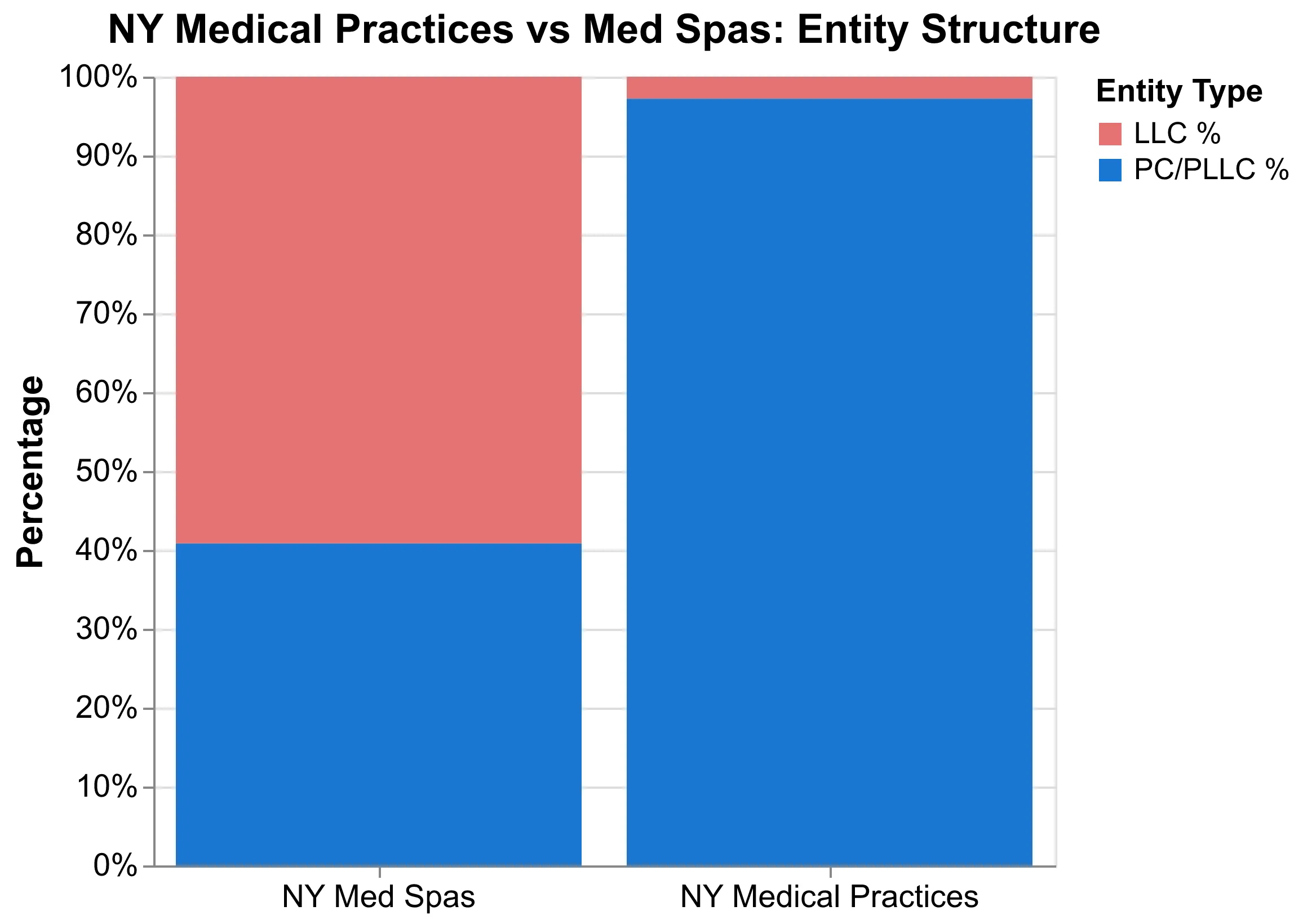
Among New York’s 618 med spa businesses, the pattern reverses: approximately 59.2% are organized as standard LLCs — a 56.4 percentage point difference from traditional medical practices.
Context matters: Not all LLC structures violate the law. Many med spas use Management Services Organizations (MSOs) — legitimate arrangements where an LLC handles business operations while a separate PC owned by a physician provides medical services. Some national chains structure each location this way to comply with state regulations.
However, a joint investigation by the NYC Council and state agencies found that many med spas fail to maintain proper separation between business and medical entities, lack physician supervision despite offering medical procedures, and operate without the required medical director oversight.
From California to Florida: A Nationwide Pattern
The structural gap persists nationwide, even in states with different regulatory approaches:
- Texas (1,575 med spas): Strict Corporate Practice of Medicine laws, yet high LLC usage
- Florida (1,469 med spas): No Corporate Practice of Medicine restrictions, allowing direct LLC ownership
- California (1,278 med spas): Strict regulations, ongoing enforcement challenges
- New York (618 med spas): Strong laws, limited inspection resources
LLC usage among new med spa registrations has consistently ranged from 68.7% to 77.4% annually — far higher than traditional medical practices — regardless of whether the state prohibits or permits non-physician ownership.
This suggests the pattern reflects something broader than state-by-state regulatory variation: an industry-wide approach to business structuring that may prioritize operational flexibility and investor access over compliance with medical practice regulations.
Why This Matters
The structural patterns we observe — beauty industry classification, high LLC usage in states that restrict it, and inconsistent entity naming — suggest systematic challenges in how med spas are regulated:
- Regulatory gaps enable risky practices: When businesses offering medical procedures classify as beauty services, they may evade medical board oversight and physician supervision requirements.
- Enforcement is inconsistent: State medical boards typically focus on individual practitioners, not business structures, leaving compliance largely to chance.
- Consumers lack transparency: Patients may not realize their provider operates outside traditional medical oversight or that their injector lacks appropriate credentials.
- Investment incentives conflict with medical regulations: The med spa model attracts private equity and franchise investment, but many states prohibit non-physician ownership of medical practices for patient protection reasons.
As New York Secretary of State Walter Mosley stated in the warning to consumers: “Unlicensed or unqualified staff, dirty needles, expired or counterfeit drugs … can lead to serious injury or even death.”
The Path Forward
The med spa industry’s rapid growth has outpaced regulatory frameworks designed for traditional medical practices or beauty salons. While many med spas undoubtedly operate responsibly through compliant MSO structures or in states that permit their business models, the enforcement actions in New York and elsewhere reveal systematic problems.
Several states have begun addressing these gaps:
- New York: Expanded inspection authority and clearer medical director requirements
- Texas: Increased penalties for unlicensed practice of medicine
- California: Enhanced enforcement against corporate practice of medicine violations
But comprehensive reform will require clearer federal guidance on when aesthetic procedures require physician oversight, standardized definitions of what constitutes a “medical spa” versus a “beauty spa,” and adequate state resources to inspect facilities offering medical procedures regardless of how they classify themselves.
Until then, consumers should verify that their med spa employs appropriately licensed practitioners, maintains a qualified medical director, and operates under the same oversight as any facility offering medical procedures — because the structural classification may not reflect the medical reality of the services provided.
Methodology
This analysis is based on Enigma’s business intelligence data, examining 12,646 businesses with “med spa,” “medical spa,” or “medspa” in their registered business names.
Data sources: Business registration records from state databases, self-reported NAICS classifications, transaction-based revenue estimates, and entity type analysis from corporate filings.
Validation approach: Our national count of 12,646 med spas aligns with industry estimates from the American Med Spa Association (AmSpa).
Important limitations:
- NAICS codes are self-reported and may not reflect actual regulatory oversight
- Entity structure alone does not indicate legal compliance or non-compliance
- Many legitimate business arrangements (MSOs, franchise models) may appear as LLCs
- State-level aggregations combine businesses operating under different local regulations
- Revenue estimates based on card transaction data may not capture full business activity
- Analysis does not examine individual compliance with state-specific requirements