Enigma Newsletter: Wyoming's Corporate Boom
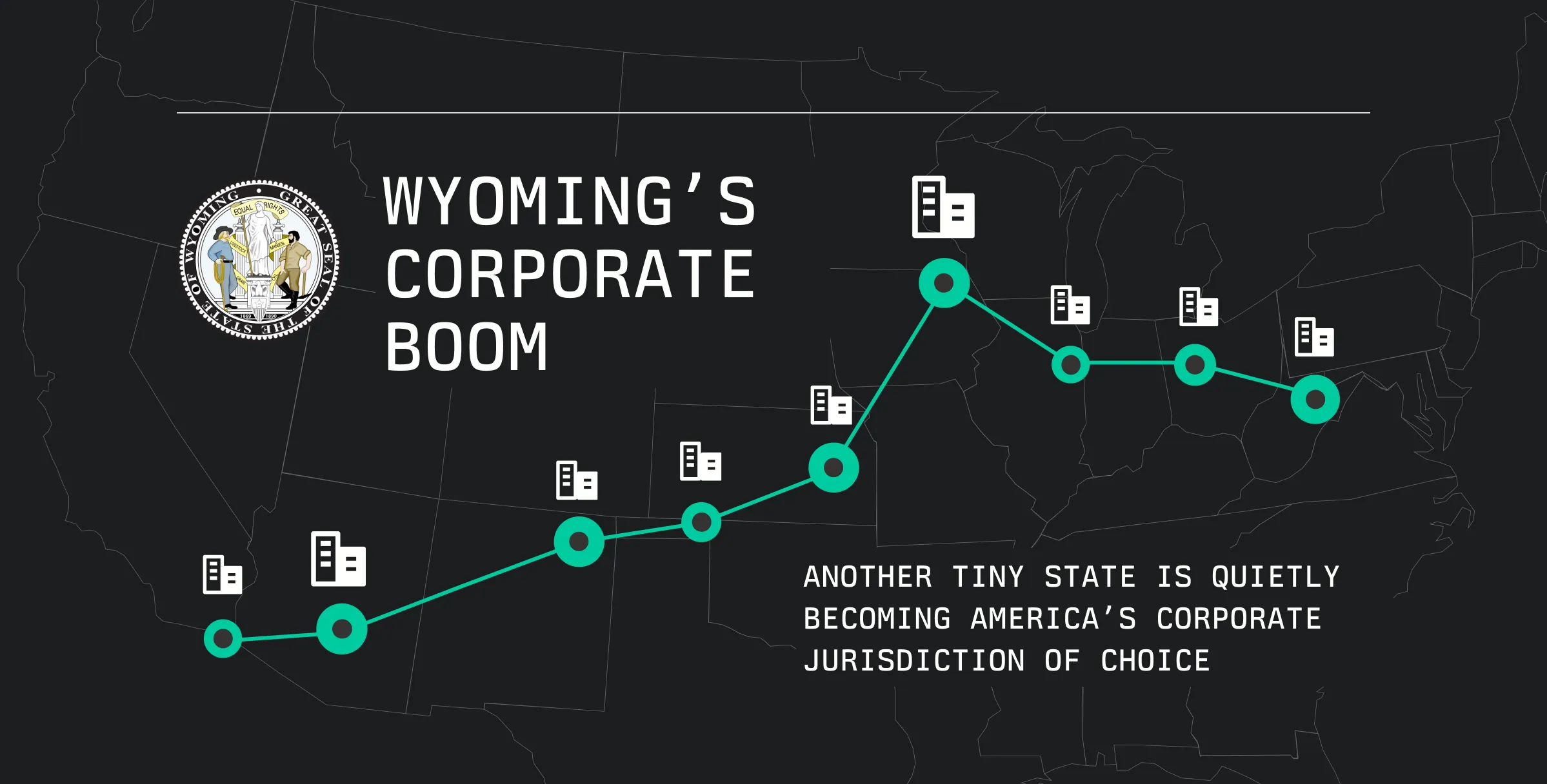
Welcome back to the Enigma newsletter. This week, we’re looking at Wyoming’s quiet rise as America’s fastest-growing corporate jurisdiction — and what it means for anyone who has to verify the businesses they work with.
But first, your weekly data points.
- Small business uncertainty declined in February for the first time in months. NFIB’s optimism index suggests Main Street is cautious but stabilizing heading into Q1. (via NFIB)
- Credit bureaus are resolving fewer consumer disputes since CFPB enforcement pulled back. Experian and TransUnion are leaving more errors on reports, a reminder that data accuracy degrades without accountability. (via ProPublica)
- A congressional investigation estimates data broker breaches have cost consumers $20 billion in identity theft losses. Major brokers are now promising easier opt-outs under pressure. (via The Markup)
- A New Jersey Girl Scout troop set up outside a cannabis dispensary and sold their whole load of cookies in one afternoon. Most GTM teams spend a quarter figuring out what these kids knew in five minutes. (via Marginal Revolution)
Wyoming’s Corporate Boom
Another tiny state is quietly becoming America’s corporate jurisdiction of choice
Every April, business owners, accountants, and formation agents file millions of new LLCs and corporations across the United States. Most choose their home state. A growing number choose Wyoming.
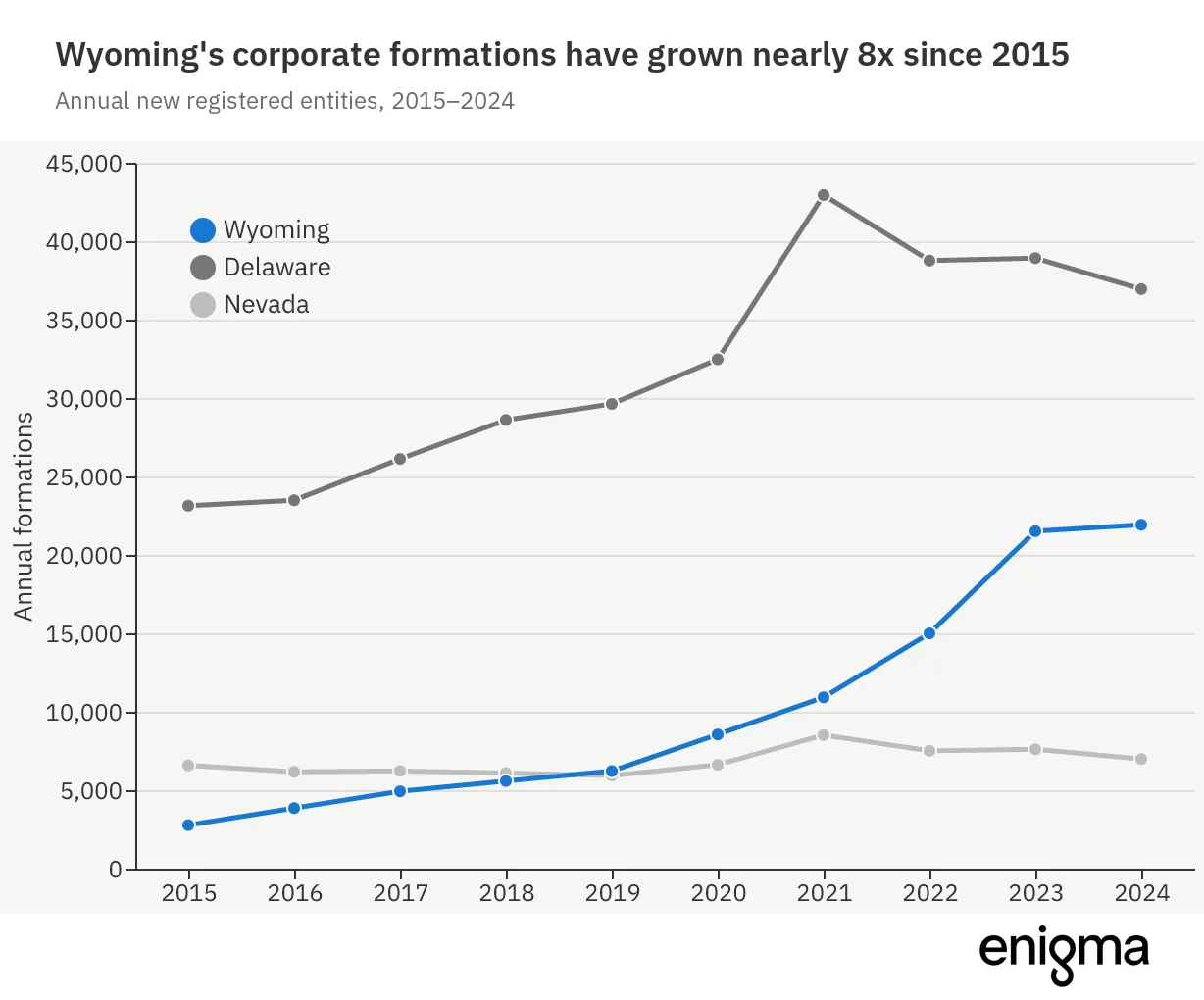
Our analysis of 13.3 million registered business entities indicates that Wyoming’s annual corporate formation volume has grown nearly 7.9x — from 2,774 new entities in 2015 to 21,921 in 2024. Wyoming now processes the equivalent of roughly 59% of Delaware’s annual volume, up from just 12% a decade ago.
Delaware Peaked. Wyoming Didn’t.
Delaware remains the preeminent corporate jurisdiction for Fortune 500 companies and VC-backed startups. Its Court of Chancery, established case law, and corporate-friendly statutes have made it the default home for institutional capital for over a century.
But Delaware’s formation numbers have stalled. Annual formations in our dataset peaked at 42,940 in 2021, a surge driven in part by the pandemic-era business formation boom. Delaware’s formation numbers subsequently declined to 36,949 in 2024. Wyoming’s formations, meanwhile, have continued rising, growing by roughly 50% between 2022 and 2024 alone.
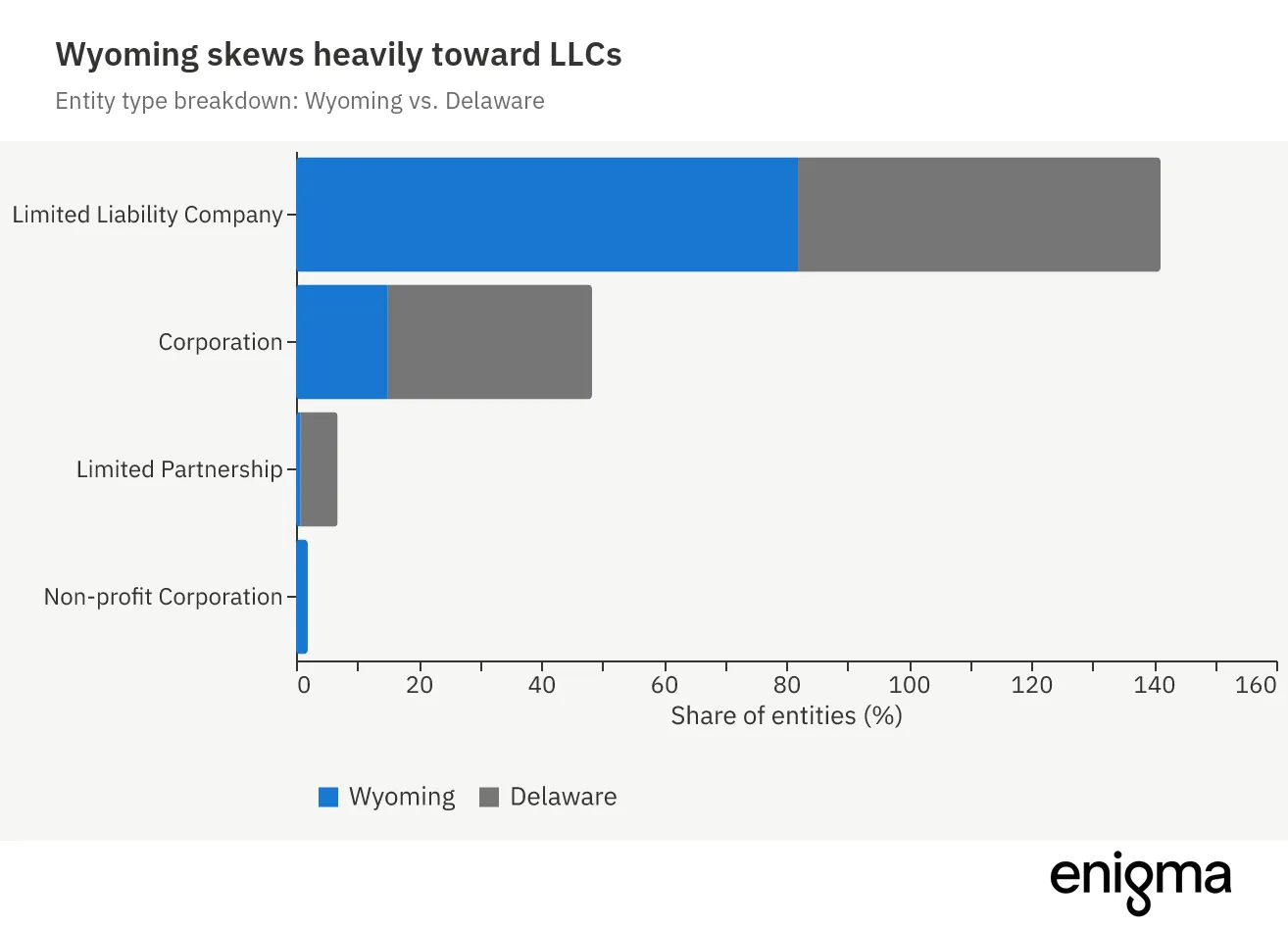
The composition of each state’s corporate roster tells part of the story. Wyoming skews heavily toward flexibility: 82% of its entities are LLCs. Delaware has a more mixed profile — 59% LLCs and 33% traditional corporations — reflecting its continued role as the C-corp home for venture-backed companies.
The Privacy Angle
What draws entrepreneurs and small businesses to Wyoming isn’t Delaware-style legal prestige. It’s something more practical: privacy and low costs.
Wyoming offers features that Delaware doesn’t match for small operators:
- No state income tax on LLCs
- $52 minimum annual fee (vs. Delaware’s minimum $300 franchise tax)
- Anonymous ownership: Wyoming LLCs are not required to disclose member names in most public filings
- Strong charging order protections: creditors face higher barriers to piercing the entity to reach owners’ personal assets
The privacy orientation shows up in the registration data. Our analysis indicates that 93% of Wyoming-incorporated entities have never registered in another state. They appear only in Wyoming’s records.
Compare that to Delaware, where 32% of incorporated entities have expanded to at least one additional state — and among those that do, the average footprint spans 2.9 states.
Registration patterns suggest Wyoming entities are less likely to be operating businesses expanding their footprint and more likely to be purpose-built holding vehicles, investment entities, or structures where anonymity is a feature — though single-state registration is also consistent with businesses that simply operate locally.
The Compliance Angle
For compliance and KYB teams, Wyoming’s rise presents a practical challenge.
Delaware’s public records, while imperfect, are searchable. Wyoming offers less. When a Wyoming LLC appears on a customer application or in a beneficial ownership disclosure, the public trail is often thin: no officer names in state filings, limited registered agent details, no operating location data.
As Wyoming formations keep growing — our data suggests no slowdown, with 2024 matching 2023’s record pace — the share of business entities with limited public registration footprints increases accordingly.
The Bottom Line
Wyoming’s formation surge reflects a rational market response: when privacy is a selling point and costs are low, formation agents route clients accordingly.
In 2015, Wyoming processed one new corporate entity for every eight Delaware-incorporated. In 2024, that ratio is closer to one in two.
For anyone who needs to verify the businesses they work with, the state on an LLC filing matters more than it used to.
Methodology
Data source: Enigma registered entities dataset, as of Q1 2026
Dataset: 13.3 million registered entity records with formation dates, home states, and cross-state registration patterns
Formation trend: Annual counts of entities with home_state matching Wyoming or Delaware, filtered to formation years 2015-2024.
Entity type breakdown: Categorized by entity type for all entities with home_state in Wyoming or Delaware.
Single-state vs. multi-state: Entities with zero foreign registrations are classified as single-state. Entities with one or more foreign registrations have expanded to additional states.
Limitations: Formation counts reflect registrations in our dataset and may not match state-published totals exactly. Relative trends and growth rates are directionally reliable even where absolute totals differ from official state counts.