
Filed Under Fiction
Inside the Unvalidated World of State Business Registrations
In August 2023, a professional corporation called Lemonade Lagoon was registered in Utah. Its leadership roster reads like a fever dream of American celebrity:
- Donald J. Trump, President
- Elon Musk, Vice President
- Melania Trump, Officer
- Joseph Rogan, Secretary
- Edward Snowden, Officer
- Jaron Lanier, Officer
The company lists addresses spanning Palm Beach, Beverly Hills, Los Angeles, and Austin. It remains active today.
Sure, it’s possible that this wide-ranging group of prominent individuals — including the current president, his wife, a tech billionaire, a leading podcaster, a whistleblower living in Russia, and a pioneer of virtual reality — have come together for a lemonade-focused professional endeavor. Or perhaps the real officers of this corporation were having a bit of fun with their paperwork.
Utah accepted the filing without question. The state issued a file number, recorded the officers, and made it official.
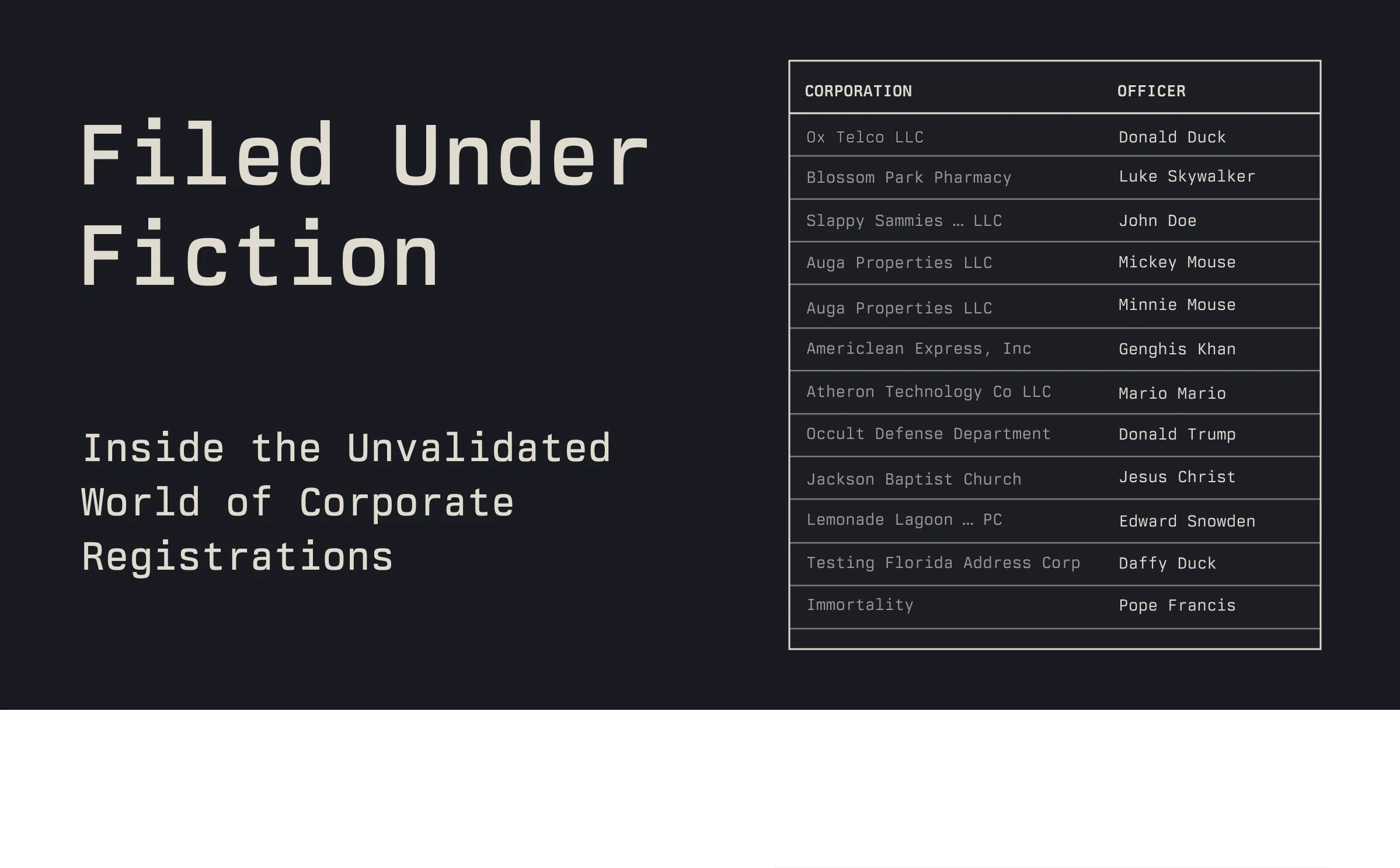
Welcome to the strange world of state business registrations, where legitimate filings may contain highly suspicious names. Where Mickey Mouse can serve as CFO, where Bill Gates and Elon Musk can co-found a school for “estoric sciences” in rural Missouri, and where someone can register Slappy Sammies Sticks for Kicks LLC with John Doe as a member.
These aren’t data errors or clerical mistakes. They’re real filings in official state corporate registries — documents formatted like authoritative records but containing information that may be false, unproven, and even ridiculous.
The Hall of Corporate Absurdity
State corporate registries are the foundation of business identity in America. When a company incorporates, its officers go on the record — names that banks will check, regulators will reference, and compliance teams will verify. The assumption is that these names mean something. But sometimes, they don’t.
We analyzed over 103 million business registrations across all 50 states and found companies that listed celebrity names, fictional characters, or obvious placeholders as corporate officers. Here are some of the most remarkable:
The All-Star Lemonade Venture
Lemonade Lagoon A Professional Corporation, registered in Utah in August 2023, assembles perhaps the most implausible executive team ever filed with a state registry. Donald Trump serves as President, Elon Musk as Vice President, Joe Rogan as Secretary, with Melania Trump, Edward Snowden, and virtual reality pioneer Jaron Lanier filling out the officer roster. The filing lists seven different addresses across five states, from Palm Beach to Beverly Hills. File number 13525371-0144 remains active and in good standing.
The Tech Billionaire Partnership That Never Was
The School of AI and Estoric Sciences — note the creative misspelling of “Esoteric” — listed Bill Gates and Elon Musk as incorporators for a company in Greenfield, Missouri. Two tech billionaires are competitors who have never been business partners, yet according to this record they have co-founded a school teaching mystical sciences in a town of 1,400 people. Missouri accepted the 2020 filing but the company was later dissolved, having never operated.
Donald Trump’s Occult Venture
The Occult Defense Department Co. was registered in Texas in September 2025, listing Donald Trump as a director. Whatever supernatural threats this company was meant to defend against, it never got around to it. No operating locations. No revenue. No actual business. But it has an official Texas file number and remains in good standing.
Slappy Sammies and John Does
In April 2022, someone registered Slappy Sammies Sticks for Kicks LLC in Arizona. The absurd name sailed through without question. So did the officers: John Doe and John Doe Elliott. Arizona accepted the paperwork, issued a file number, and made it official. The company remains active.
A Royal Tech Venture
In December 2020, someone registered Mother Queen Elizabeth I Preventive Tech-Magicare, APP in California. The name alone — combining deceased British royalty, preventive care, magical healing, and “APP” — suggests this wasn’t a serious business venture. The registered agent? Bill Gates. California accepted the filing without comment.
The Disney Executive Suite
A company called Auga Properties, LLC operated in Georgia with Mickey Mouse listed as Chief Financial Officer and Minnie Mouse as Corporate Secretary. The CEO appears to be a real person. The Disney characters are not. Georgia accepted the filing in 2006 and let it stand for years.
The Placeholder Executives
The Little White Plastic Spoon Ministries, Inc., registered in Georgia, appointed John Doe as CEO, CFO, and Secretary simultaneously. One placeholder name holding every executive position. The state approved it.
A Nationwide Phenomenon
This isn’t isolated to a few permissive states. We found celebrity officer filings across the country. Among our search for examples of the most ridiculous filings, Florida appeared most frequently, followed by California and Texas — although admittedly this reflects where we found the best stories, not a comprehensive fraud rate.
The categories of fake officers break down across several types: obvious placeholders like “John Doe” or “Jane Doe,” controversial figures (Jeffrey Epstein, Ghislaine Maxwell), politicians (Donald Trump, Joe Biden), business and tech leaders (Elon Musk, Jeff Bezos, Mark Zuckerberg), entertainment celebrities (Kanye West, Kylie Jenner), and fictional characters (Mickey Mouse, Harry Potter, Darth Vader).
What’s remarkable isn’t just that these filings exist, it’s that states continue to accept them. Slappy Sammies is still active in Arizona. Lemonade Lagoon remains in good standing in Utah. Occult Defense Department Co. was registered just months ago in Texas.
The Pattern Behind the Absurdity
Nearly all of these companies share a common trait: they never became active businesses.
When we cross-referenced the 455 companies we found with suspicious officers against Enigma’s database of 32 million+ operating businesses in the United States, we noticed that 449 out of 455 (98.7%) have zero operating signals. No physical locations. No revenue. No employees. No customer reviews. No web presence. No evidence they ever conducted business.
They exist only as paperwork — legal entities on state registries with no commercial reality behind them.
The few exceptions are telling. A small number of companies in our dataset do have business activity, but closer inspection suggests these may be legitimate businesses run by people who happen to share names with celebrities — a regular person named Michael Jordan or Will Smith, not the celebrity. The distinctive names — Elon Musk, Beyonce Knowles, Mickey Mouse — overwhelmingly appear in paper-only entities that never operated.
This pattern suggests these filings serve various purposes, none of them involving actual business:
Placeholder registrations - Formation services or lawyers creating entities that will later be transferred to real clients, using “John Doe” as a temporary name.
Abandoned ventures - Someone started the registration process as a joke or test and never finished.
Name parking - Reserving business names or entity structures for future use (or preventing others from using them).
Identity testing - Seeing whether states will accept obviously fake information (they often will).
Whatever the intent, the result is the same: state registries are filled with formally recognized businesses that list officers who don’t exist or never consented to the role.
Why It Matters for Business Verification
For compliance professionals, these phantom executives aren’t just amusing curiosities. They’re red flags about data quality.
If a business lists Mickey Mouse as CFO, what else on that registration might be fabricated? If states accept “John Doe” without verification, what about the business address? The revenue projections? The stated business purpose?
State corporate registries were designed as official records, but they function more like bulletin boards where anyone can post anything. The information is formatted like authoritative data — file numbers, issue dates, officer titles, registered agents — but in many cases it’s fundamentally unverified self-reporting.
This is precisely why Know Your Business (KYB) verification exists. The official record is a starting point, not a conclusion. Companies need to cross-reference registration data against operating signals:
- Does this business have revenue?
- Does it have physical locations with employees?
- Does it have a web presence?
- Do customers review it?
- Does it process payments?
In the vast majority of cases we identified, companies listing phantom executives fail every test. This gap between registration and reality reveals something important about business data: official doesn’t mean verified.
The real problems arise when downstream systems treat unverified registration data as verified fact. When a bank, vendor, or partner looks up a business in the state registry and assumes the listed officers are real. When compliance software auto-populates fields with officer names that were never validated. When “official state records” becomes synonymous with “true information.”
And many of these suspicious filings remain active today. The records are real. The file numbers are real. But the officers? The business itself? That requires a closer look.
Methodology
Data source: Enigma business intelligence data as of January 2026
Dataset: Analysis of 103+ million registered business entities across all U.S. states
Sample: 455 companies with celebrity names, fictional characters, or obvious placeholders listed as corporate officers
Verification approach:
- Cross-referenced company names with state corporate registry records
- Confirmed officer names and filing details through official state databases
- Checked for operating signals (revenue, locations, employees) in Enigma’s database of 32+ million active U.S. businesses
- Excluded ambiguous common-name matches (e.g., “Michael Jordan” could be someone other than the famous athlete)
- Focused on distinctive names unlikely to be coincidental (Elon Musk, Mickey Mouse, Queen Elizabeth I)
Key finding: 449 of 455 companies surfaced using this method (98.7%) showed zero operating signals—no revenue, no physical locations, no employees, no web presence
Limitations:
- Sample selected for clear examples of absurd filings, not statistical representation
- Cannot definitively prove intent behind false officer names
- State distribution reflects where we found the best examples, not comprehensive fraud rates
- Some legitimate businesses may employ people who coincidentally share celebrity names
Geographic distribution: Companies identified across multiple states, with Florida, California, and Texas appearing most frequently in our curated examples
All company file numbers and formation dates are available upon request.