
How Much Is a Verification Worth?
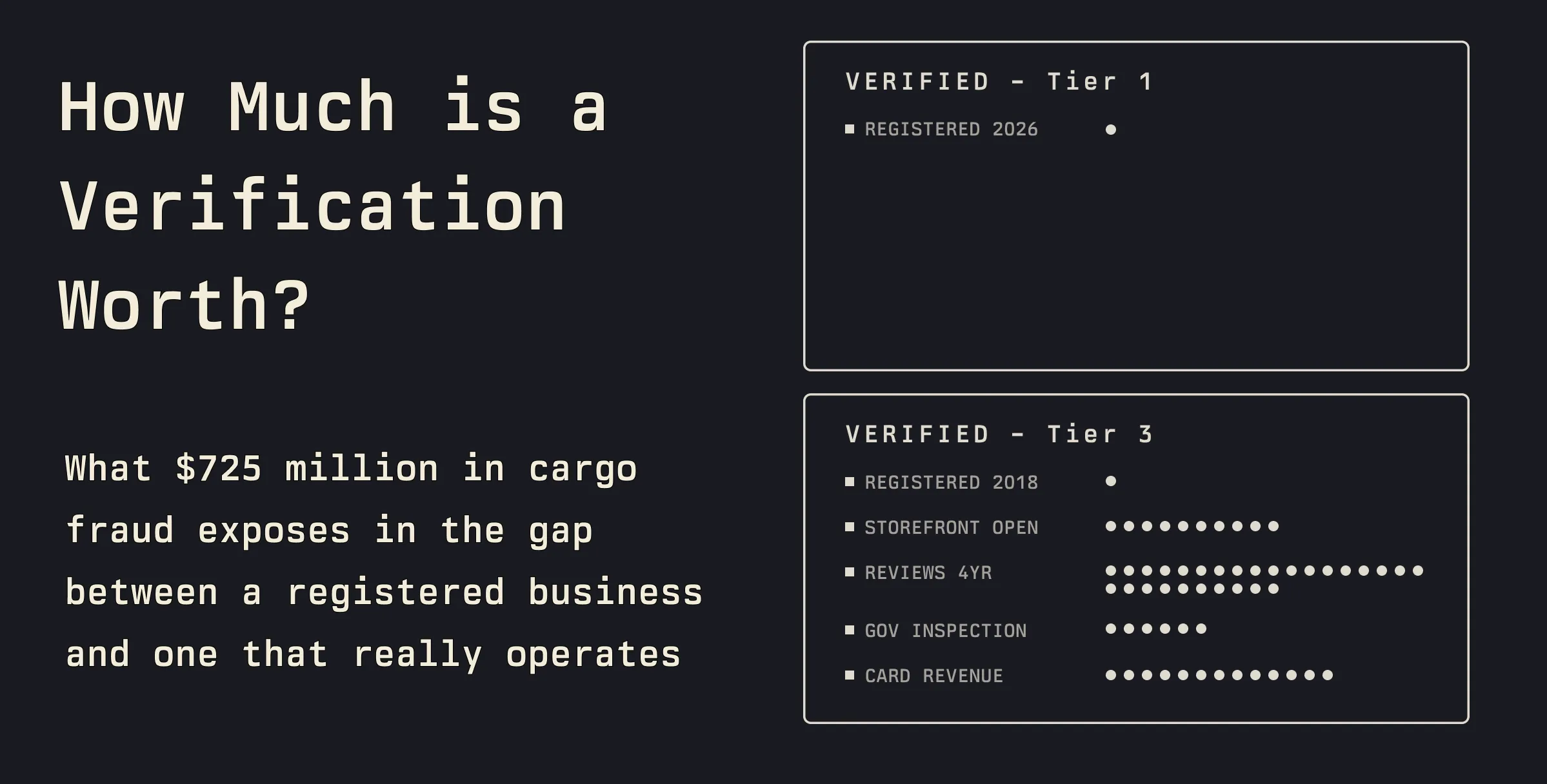
Cargo theft losses reached roughly $725 million in 2025, up about 60% in a year, with the average theft now worth $274,000, according to Verisk CargoNet. A growing share runs through one quiet mechanic: a fraudulent or reincarnated freight broker. The broker registers with the Federal Motor Carrier Safety Administration, gets an MC number, posts a bond, and within days is bidding on loads. A shipper, or the factoring company financing the load, runs a KYB check: the MC number is active, the bond is on file, the check passes. Then the cargo disappears, or the load is double-brokered to a real carrier who hauls it for a payment that never arrives. Every check came back clean, because every check was reading the same thin layer, the registration paperwork anyone can produce for a filing fee.
That thin layer is what a pass-or-fail verification hides. A broker that has operated for years and a shell registered last week can return the identical verdict: verified. The evidence behind the two is not remotely equal, and a single bit of output erases the difference.
That’s the critical difference we built verification tiers to measure: a structured verdict that reports the strength of the evidence behind a KYB check, ranked by how independently a business’s existence can be corroborated.
These tiers stand on the independence of evidence, because this is the quality that matters most when you judge whether to trust a record. A registration is not independent data, because the business itself filed it with self-reported information. But a card-transaction record is independent, because a payment processor produced it. So is a customer review, or a government inspection, and each one is harder to fake than the last. Falsifiability is the same axis from the cost side: forging one review is trivial, but manufacturing years of reviews, card revenue, and a government record costs more than even operating a real business.
Verification works in three tiers:
- Tier 1, trust-based: registrations and EINs, which are uncorroborated paperwork.
- Tier 2, one independent signal: a basic business license, web presence, or third-party review.
- Tier 3, multiple independent signals with time depth: a sustained review history, an open location, twelve months of card activity, a government record beyond the registration.
Tiered verification returns the tier alongside the evidence that earned it, so a risk team can take the verdict as a default or write its own policy against the underlying signals.
What “Active” Really Means in Freight
Now back to that broker. How wide is the gap? As of June 2026, the FMCSA census lists 111,682 broker authorities that read as active. Yet in our analysis of FMCSA filings, the number carrying a current surety bond a broker must hold to operate is fewer than 25,000. Roughly one in four and a half. The other 87,000 active-reading dockets are mostly dormant or never fully activated. A Tier 1 check cannot tell a staged company apart from the real thing. They all read as “active.”
We know from court records, an especially hard-to-fake signal, how these scams are pulled off. In 2024, a federal jury convicted Tony Kirik of defrauding the FMCSA by re-registering trucking businesses to shed a compromised safety record and re-emerge clean, according to the Department of Transportation’s Office of Inspector General. His crime was the registration layer itself: laundering a dangerous safety history into a clean one. Technically this would pass many providers’ baseline for KYB. Across adjudicated freight-fraud cases, the move repeats over and again: an operator hides a prior FMCSA entity behind a new application, and the new authority reads clean on day one.
Reliable verification signals come through independent evidence, not self-reported paperwork. Among the roughly 94,000 freight brokers in Enigma’s data, counted independently of the FMCSA register, a website separates almost no one: about three in four have one, fraudulent or not, because a website costs almost nothing. What distinguishes an operating business is the expensive-to-fake evidence: a sustained card-payment record, a verified location, a multi-year track record. These rarely appear for a shell, and rarely appear alone for a real business. Their presence is expensive to fake, but most legitimate brokers settle by invoice rather than card, so the absence of these signals proves nothing.
Verification tiers report what a clean check is worth. A company has the choice to trust its cargo with a Tier 1-only broker, or extend credit only once independent history exists. But this is bigger than cargo theft. A verdict that says a business is “active” is the same in freight, in banking, in procurement. The tier is the part that tells you whether to trust it.