
Agents are built to reason, not resolve
Enigma has joined TinyFish’s Data Partners Alliance, making fully linked business data reachable by the agents doing real work on the web
Agents can read the open web, but most of what they need to do real work does not live there. It is licensed, gated, or behind a paywall, and no crawler will return it.
TinyFish builds the infrastructure agents use to reach the web. Its Data Partners Alliance brings together fifteen data companies across ten categories. Enigma is one of the founding fifteen.
Enigma delivers what agents can’t assemble themselves: every U.S. business already resolved and connected to the people and places behind it, each fact traceable to its source, so teams can trust what their agents return.
The failure starts with resolution
Automated traffic reached 53% of all web traffic in 2025, up from 51% the year before, according to Imperva’s 2026 Bad Bot Report. Most of that is the automation the web has always carried. What is new is the category of agents that retrieve data, run workflows, and act on a person’s behalf. Research, enrichment, monitoring, diligence, and answers someone acts on.
Models excel at reasoning. Where they fall short on their own is resolving the relationships between entities.
It starts in the data. Business identifiers collide. Names repeat. Addresses overlap. The same officer name appears across companies with no relationship to one another. The signal that separates them rarely sits inside any single dataset, so an agent asked to resolve a business is being asked for something the data it has cannot give it: the relationships.
It resolves anyway. There is no error state for a business an agent cannot identify. It returns its best approximation and carries on.
Nothing marks the difference. A resolved answer and an inferred one arrive in the same shape, worded with the same certainty.
Then it travels. The next step takes it as established truth, and the next agent can build on it. By the time anyone questions the result, the error is several steps down the chain and no one can point to the record that was wrong.
When dealing with business data, that is a failure that must be designed against. This partnership is built to prevent the serious risk of models joining real records incorrectly and the dangerously wrong answers that follow.
Grounding in a broader truth, and the network around it
Grounding is only as good as the data agents are grounded in. Tying an output to an external source makes a claim attributable rather than generated, but ground an agent in a single record and the claim is attributable to a fragment. It still guesses at everything that record is connected to.
A single record tells an agent what a business is called. It does not tell it who owns it, where else it operates, or what else it touches.
Enigma grounds agents in the business and its network, giving them authoritative access to public, private, and proprietary data linked across 100M+ U.S. businesses, 75M key people, 33M brands, and 31M locations.
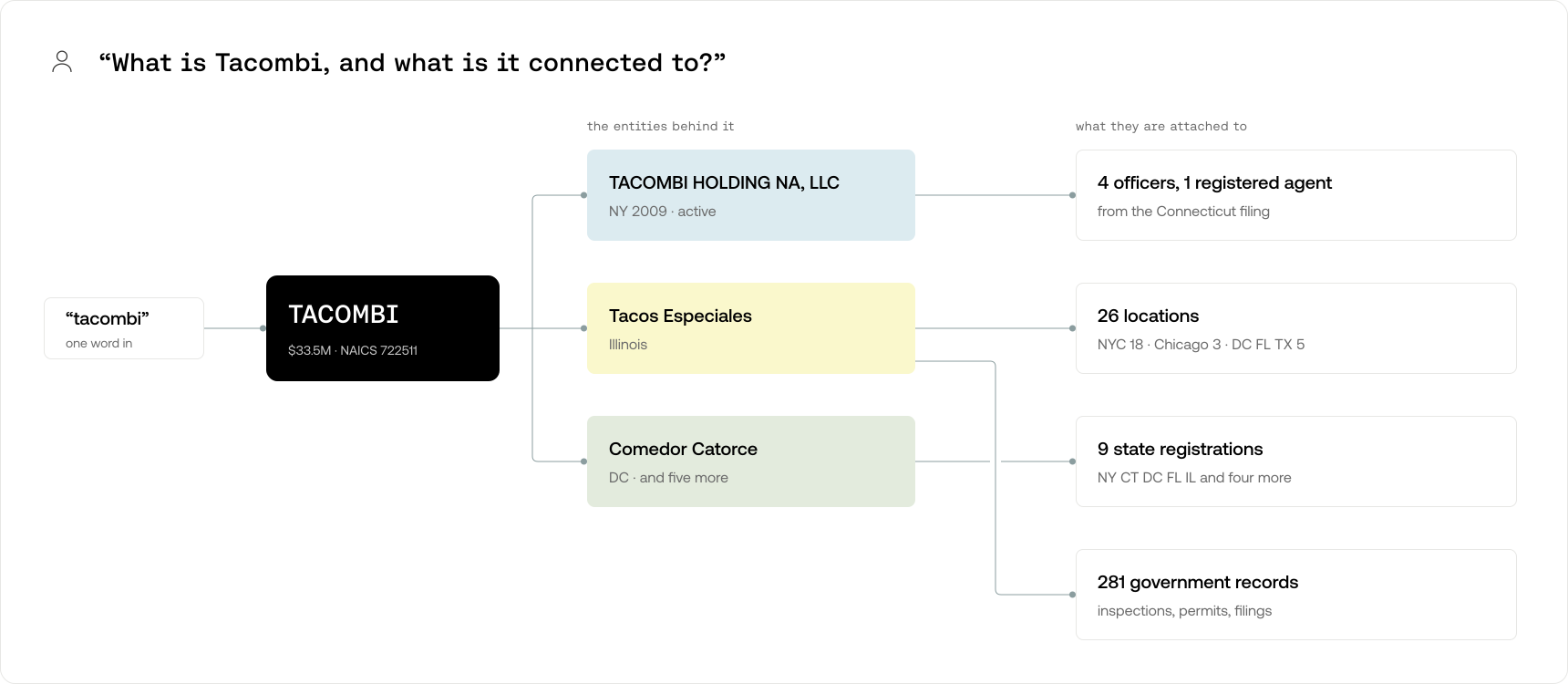
Three things come out of that, and together they are what lets a team build on an agent’s output instead of checking it:
- The network: Owners, officers, locations, legal entities, and affiliated entities arrive already linked. An agent can traverse instead of looking up one business at a time, which is what makes questions like these answerable. Does this person control other businesses? Does this company operate other locations? Is this customer new, or is there a history here?
- Provenance: Every fact carries its source and date, so an agent can check it instead of assuming it.
- Confidence: One name in, the entity and its network out. Or nothing, which is an answer too, and no one model will give you on its own. Either way the agent gets something it can act on rather than something it inferred, making it safe to run the next step.
Not optional
This is where agent infrastructure has to go: agents are built to reason, not resolve, and forcing the issue doesn’t make a workflow smarter. It makes it confidently wrong in a way that cascades risk all the way down the chain.
None of this is new for us. Enigma has been tackling this problem for 15+ years across a range of use cases. We power knowledge graphs in agentic research indexes, KYB compliance agents on Google Cloud, verified business identity bound to cryptographic authorizations, and now we supply licensed business data to agents doing live work on the web.
Business identity has to arrive already resolved, not reasoned into existence by the agent using it.
Try it
Have your agent send a business name
It gets back the resolved entity, its network, and the source behind each link. If you’re building on TinyFish and want Enigma in your agent, ask for us on the partners page.